

2026 Hyundai Elantra or 2026 Hyundai Sonata: Key Differences for Ontario Sedan Shoppers
2026 Hyundai Elantra or 2026 Hyundai Sonata: Key Differences for Ontario Sedan Shoppers
Posted on July 7, 2026
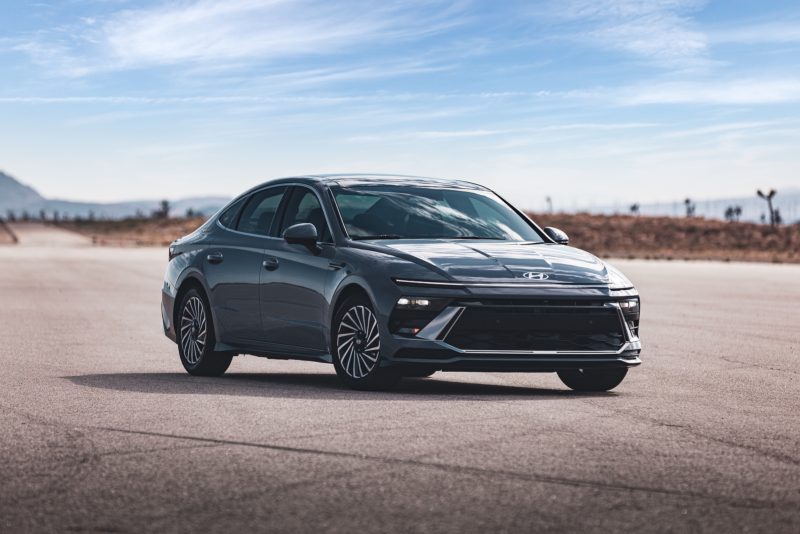
Hyundai builds two very different sedans under one roof. The Elantra and Sonata share safety technology and a dealership, but the similarities mostly end once you look at size, seating, and how each one drives.
For Ontario shoppers weighing both, the real question is not which sedan is better. It is which one matches how you actually use a car every day.
Elantra vs Sonata at a Glance
| Spec | Elantra | Sonata |
| Body style | Compact sedan | Midsize sedan |
| Wheelbase | 2,720 mm | 2,840 mm |
| Overall length | 4,675 mm | 4,910 mm |
| Trunk volume | 402 L | 441 L |
| Base engine | 2.0L four-cylinder, 147 hp, 132 lb-ft | 2.5L four-cylinder, 191 hp, 181 lb-ft |
| Hybrid engine | 1.6L hybrid, 139 hp combined, 195 lb-ft combined | 2.0L hybrid, 192 hp combined, 151 lb-ft |
| N Line Ultimate engine | 1.6L turbo, 201 hp, 195 lb-ft | 2.5L turbo, 290 hp, 311 lb-ft |
| Combined fuel economy (gas) | 6.8 L/100 km | 8.6 L/100 km (AWD) |
| Drivetrain | FWD across the lineup | FWD (HEV, N Line) or AWD (Preferred Trend AWD) |
Powertrain and Driving Feel
The Elantra’s base 2.0L engine makes 147 hp and 132 lb-ft of torque through a Smartstream IVT, tuned for smooth commuting rather than quick launches. Move up to the Luxury Hybrid and the 1.6L hybrid system drops combined fuel economy to 4.7 L/100 km, well below the base gas engine’s 6.8 L/100 km.
Sonata’s Preferred Trend AWD carries a 2.5L engine with 191 hp and 181 lb-ft, paired with Hyundai’s HTRAC all-wheel drive, a layout the Elantra lineup does not offer. The Preferred Trend HEV swaps in a 2.0L hybrid system rated at 192 hp combined, landing at 5.0 L/100 km combined in a larger, heavier body.
Both sedans offer an N Line Ultimate for buyers who want sharper acceleration. The Elantra’s version pairs a 1.6L turbo engine with 201 hp and 195 lb-ft. The Sonata’s N Line Ultimate steps up to a 2.5L turbo making 290 hp and 311 lb-ft, a bigger jump in output to match its larger footprint.
If low running costs in a smaller footprint is the priority, the Elantra Hybrid’s 4.7 L/100 km combined rating is hard to match in this lineup. If all-wheel traction or stronger outright power matters more, the Sonata’s AWD and N Line Ultimate options cover that ground instead.
Interior Comfort and Cabin Space
Sonata’s 2,840 mm wheelbase, 120 mm longer than the Elantra’s 2,720 mm, adds real stretch-out room, addressing the knee-space compromise common in compact sedans. Overall length grows from 4,675 mm on the Elantra to 4,910 mm on the Sonata.
Trunk space follows the same pattern: 402 L in the Elantra versus 441 L in the Sonata, a real difference for anyone regularly hauling strollers, hockey bags, or grocery runs for a full family.
Seating materials split by trim more than by model. The Elantra’s Essential and Preferred trims use cloth, Luxury and Luxury Hybrid step up to leatherette, and only the N Line Ultimate gets leather sport seats. The Sonata’s Preferred Trend AWD and Preferred Trend HEV both include leather seating from their starting point, with heated and ventilated front seats standard on those two trims.
Climate control tells a similar story. The Elantra’s Essential and Preferred trims rely on manual air conditioning, with dual-zone automatic climate control arriving at Preferred Tech and above. Every Sonata trim, from Preferred Trend AWD through N Line Ultimate, includes dual-zone automatic climate control with a touch-enabled screen controller.
For a driver who wants a smaller car to park and manoeuvre daily, the Elantra’s compact dimensions are the appeal. For a driver who wants rear-seat space and climate features standard from the first trim, the Sonata’s larger body delivers that without climbing the trim ladder.
Technology and Everyday Connectivity
The Elantra’s Essential trim starts with an 8-inch touchscreen, a 4.2-inch gauge cluster, and six-speaker audio, all with wireless Android Auto and Apple CarPlay. Stepping up to Preferred Tech, Luxury, Luxury Hybrid, or N Line Ultimate swaps in dual 10.25-inch displays, a digital cluster paired with a touchscreen, with Luxury and above also adding Bose eight-speaker audio and a wireless charging pad.
The Sonata’s Preferred Trend AWD and Preferred Trend HEV both start with a 12.3-inch touchscreen and a 4.2-inch multi-information display, already larger than the Elantra’s base setup. The N Line Ultimate steps up to a 12.3-inch navigation touchscreen paired with a 12.3-inch digital cluster and Bose 12-speaker premium audio, plus a wireless charging pad standard on that trim alone.
Driver-assistance coverage differs by lineup, not just by trim. The Sonata brings adaptive cruise control with stop-and-go, blind-spot collision warning, and rear cross-traffic alert to every trim in its lineup. The Elantra reserves adaptive cruise control for Luxury, Luxury Hybrid, and N Line Ultimate, with blind-spot and rear cross-traffic starting one step lower at Preferred.
Standard across every Sonata trim: - Adaptive Cruise Control with stop-and-go - Blind-Spot Collision-Avoidance Warning - Rear Cross-Traffic Collision-Avoidance Assist
Which Hyundai Fits Your Drive?
If your daily drive is mostly solo commuting, errands, and tight parking, the Elantra’s compact size and Hybrid trim’s 4.7 L/100 km combined rating make it the practical pick. It is the Hyundai sedan built around keeping costs and dimensions small.
If you are regularly carrying passengers, need more trunk room for family gear, or want adaptive cruise control and dual-zone climate control standard from the first trim, the Sonata’s larger cabin and broader standard-feature list make it the better starting point.
Buyers chasing a sportier drive have a choice within each body size. The Elantra N Line Ultimate delivers a quicker, smaller sedan; the Sonata N Line Ultimate delivers more outright power in a larger one. Neither is a downgrade from the other; they are built for different garages.
Compare Both Sedans at Guelph Hyundai
Every Hyundai sedan, including the Elantra and Sonata, carries a 5-year/100,000 km New Vehicle Warranty, extending well past the typical 3-year coverage found elsewhere in the segment. Whichever one fits your routine, that coverage travels with it.
Visit Guelph Hyundai in Guelph to sit in both the Elantra and Sonata, compare their cabin space and technology in person, and find the sedan that matches your daily drive.