

2026 Hyundai Santa Fe vs 2026 Mazda CX-90: Family SUV Comfort in Ontario
2026 Hyundai Santa Fe vs 2026 Mazda CX-90: Family SUV Comfort in Ontario
Posted on June 30, 2026
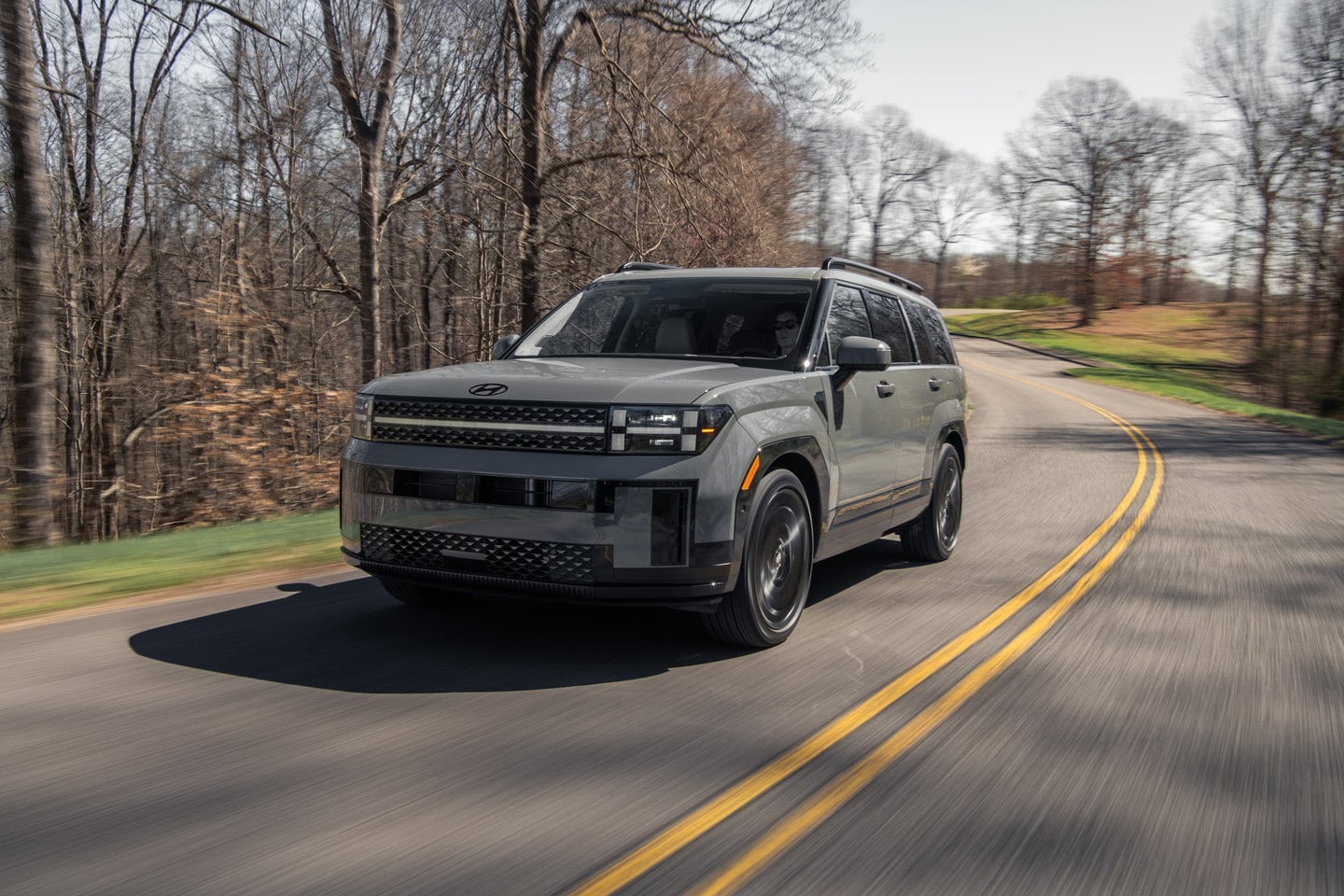
Two three-row hybrid SUVs, two very different takes on electrification. The 2026 Hyundai Santa Fe Hybrid runs a full-hybrid system that pairs its 1.6L turbocharged engine with an electric motor at all times, no plug required. The 2026 Mazda CX-90 offers a mild-hybrid 3.3L inline-six or a plug-in hybrid 2.5L four-cylinder. For Ontario families who want genuine fuel savings on every trip without a charging routine, the Santa Fe’s approach is worth a close look.
The lineups differ in scope too. The Santa Fe offers four focused trims; the CX-90 spans a wide range of powertrains and prices. Here is how both compare on the specs that drive the decision.
2026 Santa Fe Hybrid vs. 2026 CX-90: Side by Side
| Feature | 2026 Santa Fe Hybrid | 2026 CX-90 MHEV (GS) |
| Engine | 1.6L Turbo 4-cyl Hybrid | 3.3L Inline-6 Turbo MHEV |
| Combined System Output | 231 hp / 271 lb-ft | 280 hp / 332 lb-ft |
| Fuel Economy (combined) | 6.9 L/100km | 9.4 L/100km |
| AWD | Standard, all trims | Standard, all trims |
| Max Towing (braked) | 2,000 lbs (907 kg) | Up to 5,000 lbs (2,268 kg)† |
| Cargo Behind 3rd Row | 413 L | 423 L |
| Seating (base trim) | 7 passengers | 8 passengers |
†CX-90 MHEV GT-L with Mazda Genuine Towing Accessories
Powertrain and Efficiency
The Santa Fe’s 1.6L turbocharged four-cylinder pairs with a 59 hp electric motor and a 1.49 kWh lithium-ion battery, delivering 231 combined hp and 271 lb-ft of torque. Transport Canada estimates 6.9 L/100km combined, a clear lead over the CX-90 MHEV GS’s 9.4 L/100km on its 3.3L inline-six.
The CX-90 MHEV’s 280 hp and 332 lb-ft give it stronger raw output, and its 48V mild-hybrid system sharpens low-speed throttle response. A mild hybrid recaptures less energy than a full hybrid, and that gap shows at the pump. City driving is exactly the scenario that favours the Santa Fe’s full-hybrid architecture.
The CX-90 also offers a PHEV variant, pairing a 2.5L four-cylinder with a larger battery for up to 43 km of electric-only range. That option works well for short daily trips with reliable home charging. The Santa Fe covers the same commuting ground without requiring a plug, and enters the market at a lower price point.
Interior, Tech, and Trim Walk
The Santa Fe’s four trims build logically. The Preferred opens with 7-passenger seating, cloth upholstery, a 12.3-inch touchscreen, wireless Apple CarPlay and Android Auto, heated front seats, and 18-inch wheels. The Preferred with Trend Package upgrades to leatherette, a dual-panel sunroof, 20-inch wheels, a 12.3-inch digital gauge cluster, wireless charging, and Hyundai Digital Key.
The Luxury trim marks the comfort pivot: full leather seats, ventilated front seats, heated second-row seats, a driver’s memory system, surround view monitor, blind view monitor, built-in navigation, and Highway Driving Assist 1. The Calligraphy trim steps to 6-passenger captain’s chair seating, Nappa leather, a 12-inch head-up display, Bose 12-speaker audio, dual wireless charging, Highway Driving Assist 2, and Remote Smart Parking Assist.
The CX-90 GS starts with 8 passengers and a 10.25-inch display; the GT brings Nappa leather, ventilated front seats, heated second-row seats, and a Bose 12-speaker system. The CX-90’s upper trims reach well beyond the Santa Fe’s price range. For families who want leather comfort and advanced driver aids without climbing that far, the Santa Fe Luxury delivers a comparable feature set at a more accessible entry.
Capability and Size
Towing is the CX-90’s clearest advantage: up to 5,000 lbs (2,268 kg) on the MHEV GT-L with Mazda Genuine Towing Accessories, against the Santa Fe’s 2,000 lbs (907 kg) braked rating. For families who regularly haul a large trailer, that gap is real and worth weighing.
For everyday cargo use, both SUVs are closely matched. The Santa Fe offers 413 L behind the third row, 1,148 L behind the second row, and 2,267 L with everything folded. The CX-90 PHEV shows 423 L behind its third row, a minor difference for typical family loading.
The Santa Fe is also more compact at 4,830 mm long with a 2,815 mm wheelbase. The CX-90 PHEV stretches to 5,100 mm, a step that can complicate parking in tighter Ontario lots and parkades.
Which One Is Right for You?
For most Ontario families, the Santa Fe Hybrid is the practical, lower-running-cost choice. Its 6.9 L/100km combined rating delivers real savings over the CX-90 MHEV’s 9.4 L/100km, with no charger required. The 8-year / 160,000 km hybrid battery warranty adds long-term ownership confidence that stands out in this segment.
The CX-90’s higher towing rating is a genuine differentiator for buyers who haul large trailers on a regular basis. But for the family that wants three rows, efficient everyday driving, standard AWD across every trim, and a lineup that rewards mid-level buyers, the Santa Fe Hybrid makes the stronger case, without asking for a premium price or a charging routine.
Make Your Choice at Guelph Hyundai
The 2026 Santa Fe Hybrid brings a full-hybrid powertrain, standard AWD, and a 6.9 L/100km combined fuel rating to the three-row segment, backed by an 8-year / 160,000 km hybrid battery warranty that is rare at this size.
Visit Guelph Hyundai in Guelph to explore the Santa Fe Hybrid lineup in person and book a test drive that fits your schedule.