

How Much Cargo Space Does Each 2026 Hyundai SUV Actually Have?
How Much Cargo Space Does Each 2026 Hyundai SUV Actually Have?
Posted on April 28, 2026
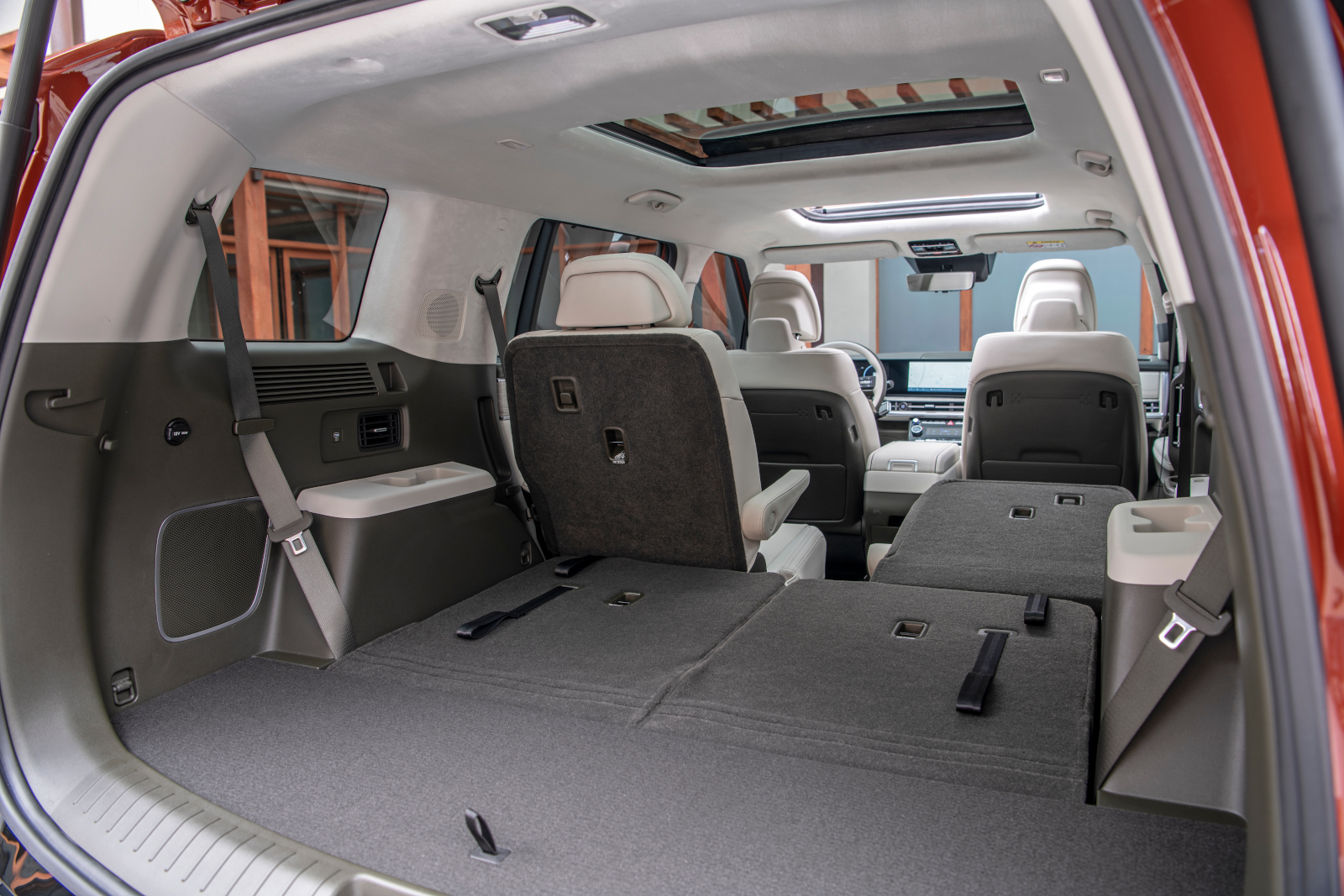
Cargo space is one of the most practical questions buyers ask about any SUV. How much fits behind the rear seats? What happens when you fold them down? Does it actually fit the stroller, the hockey bags, the camping gear, or all of the above? Hyundai's 2026 SUV lineup covers a wide range — from a compact urban crossover to a full-size three-row flagship — and the cargo numbers reflect that span clearly.
This ranking covers every gas-powered 2026 Hyundai SUV available in Canada, ordered from smallest to largest cargo capacity with seats in the standard position. All figures are SAE-measured and pulled from official Hyundai Canada documentation. If you're shopping based on how much space you actually need, this is the breakdown worth reading.
#5 — Venue: 528 Litres
The 2026 Venue is Hyundai's entry-level SUV, and it earns its spot at the bottom of the cargo rankings by design. It's built for urban use and shorter trips — not heavy hauling. Behind the rear seats, cargo volume sits at 528 L. Fold the rear bench flat and that opens up to 902 L, which handles flat-pack furniture runs or a full weekend's worth of gear for two people.
The Venue runs on a 1.6L inline-4 engine producing 121 horsepower and 113 lb-ft of torque, front-wheel drive only, with a continuously variable transmission. Fuel economy is rated at 7.9 L/100 km city and 6.9 L/100 km highway. At 4,040 mm in overall length, it's also the easiest Hyundai SUV to park in Guelph's older downtown core.
- Cargo (seats up): 528 L
- Cargo (seats down): 902 L
- Engine: 1.6L I4, 121 hp
- Drive: FWD only
#4 — Kona: 723 Litres
The 2026 Kona more than doubles its footprint on the cargo leaderboard compared to the Venue — 723 L with the rear seats up and 1,803 L with them folded. This is where the Kona becomes a genuinely capable road trip and active-lifestyle vehicle, not just a city runner.
The standard 2.0L engine handles most buyers' needs well, while the N Line and N Line Ultimate trims add a 1.6L turbocharged engine for a more spirited drive. AWD is standard on the Preferred Trend, N Line, and N Line Ultimate trims — relevant for Guelph area drivers who face real winter conditions from December through March. All trims include a dual-level cargo floor, which helps with load management.
- Cargo (seats up): 723 L
- Cargo (seats down): 1,803 L
- AWD: Standard on upper trims
- Trims: Essential, Preferred, Preferred Trend, N Line, N Line Ultimate
#3 — Tucson: 1,095 Litres
The 2026 Tucson takes a significant step up in practical cargo capacity at 1,095 L with the rear seats in place. With five seats and HTRAC all-wheel drive standard across the entire lineup, this is Hyundai's most versatile five-passenger SUV.
Powertrain options give buyers real flexibility: the Preferred and XRT trims use a 2.5L naturally aspirated gas engine, while the N Line and Ultimate trims step up to a 1.6L turbocharged hybrid. The Ultimate trim also offers the 1.6L Turbo Plug-in Hybrid with 268 horsepower, which gives drivers the option of short commutes on electric power and longer trips on gas. Fold the rear seats flat and total cargo reaches 2,119 L — nearly double the seats-up figure.
- Cargo (seats up): 1,095 L
- AWD: HTRAC standard across all trims
- Hybrid available: Yes — 1.6L Turbo HEV (N Line, Ultimate) and 1.6L Turbo PHEV (Ultimate)
#2 — Santa Fe: 1,148 Litres (Second Row Up) / 413 Litres (Third Row Up)
The 2026 Santa Fe sits in an interesting position in this ranking. As a three-row SUV, cargo numbers depend heavily on which rows you're using. With the third row in use, there's 413 L behind it — enough for a few bags, but tight if you're loading groceries for a full family. Fold the third row and that opens up to 1,148 L. Max out the load floor with all seats down and you have 2,267 L to work with.
The Santa Fe Hybrid is powered by a 1.6L turbocharged 4-cylinder producing 226 horsepower combined. This is the default powertrain for the 2026 Santa Fe in Canada. If three rows are on the list but you want to keep the budget grounded, the Santa Fe is where that conversation starts.
#1 — Palisade: 540 Litres (Third Row Up) / 1,310 Litres (Second Row Up) / 2,455 Litres (All Down)
The all-new 2026 Palisade is the cargo capacity leader in Hyundai's lineup, and the numbers show it across every configuration. With three rows occupied, 540 L sits behind the third row — the most cargo-behind-the-third-row of any Hyundai SUV. Fold the third row and you're at 1,310 L. Fold both rows flat and the load floor opens to 2,455 L.
This is the SUV for families who regularly move large items, haul gear for outdoor trips, or travel with three full rows of passengers and still need room for bags. The 3.5L V6 engine produces 287 horsepower and 260 lb-ft of torque, offering a towing capacity of 5,000 lbs (2,268 kg). The available 2.5L turbocharged hybrid pushes combined output to 329 horsepower with a towing capacity of 4,000 lbs (1,814 kg) and a range exceeding 800 kilometres.
The 2026 Palisade is also physically larger than its predecessor — the body grew 65 mm in length and the wheelbase extended 70 mm, both contributing to the expanded interior and cargo capacity.
- Cargo (3rd row up): 540 L
- Cargo (2nd row up): 1,310 L
- Cargo (all down): 2,455 L
- Towing (V6): 5,000 lbs (2,268 kg)
- Towing (Hybrid): 4,000 lbs (1,814 kg)
At a Glance: 2026 Hyundai SUV Cargo Rankings
| Model | Cargo (Seats Up) | Cargo (Max) | Rows |
|---|---|---|---|
| Venue | 528 L | 902 L | 2 |
| Kona | 723 L | 1,803 L | 2 |
| Tucson | 1,095 L | 2,119 L | 2 |
| Santa Fe | 413 L (3rd row) / 1,148 L (2nd row) | 2,267 L | 3 |
| Palisade | 540 L (3rd row) / 1,310 L (2nd row) | 2,455 L | 3 |
See the Full Lineup at Guelph Hyundai
If you're narrowing down which 2026 Hyundai SUV has the space you need, the team at Guelph Hyundai can help you compare models in person and get a sense of how your gear actually fits. Stop in at our Guelph location to take a look, ask questions, and get behind the wheel of the one that makes the most sense for your day-to-day.